| FindBook |
有 1 項符合
The Quest for a Lost Race (Illustrations)的圖書 |
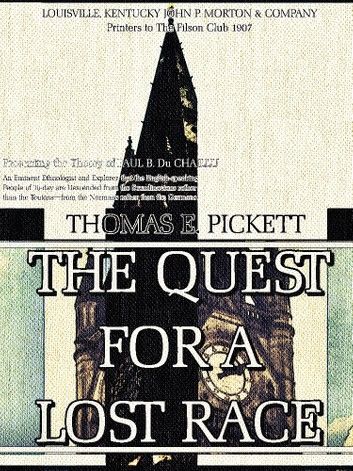 |
The Quest for a Lost Race (Illustrations) 作者:Thomas E. Pickett 出版社:Filson Club Publications 出版日期:2015-03-19 語言:英文 |
 樂天KOBO
| 圖書館借閱 |
| 國家圖書館 | 全國圖書書目資訊網 | 國立公共資訊圖書館 | 電子書服務平台 | MetaCat 跨館整合查詢 |
| 臺北市立圖書館 | 新北市立圖書館 | 基隆市公共圖書館 | 桃園市立圖書館 | 新竹縣公共圖書館 |
| 苗栗縣立圖書館 | 臺中市立圖書館 | 彰化縣公共圖書館 | 南投縣文化局 | 雲林縣公共圖書館 |
| 嘉義縣圖書館 | 臺南市立圖書館 | 高雄市立圖書館 | 屏東縣公共圖書館 | 宜蘭縣公共圖書館 |
| 花蓮縣文化局 | 臺東縣文化處 |
|
|
Example in this ebook
While the Home-Coming Kentuckians were enjoying their meeting, in Louisville, in the month of June, 1906, Doctor Thomas E. Pickett published a newspaper article which he had written for the Home-Coming Week, the object of which was to present the theory of Paul B. Du Chaillu as to the descent of the English-speaking people from the Scandinavians instead of the Teutons; and to show that the descendants of these Scandinavians were still existing in different countries, and especially in Kentucky. The author sent me a copy of his article, and after reading it I deemed it an ethnological paper worthy of a more certain and enduring preservation than a daily newspaper could promise, and concluded that it would be suitable for one of the publications of The Filson Club. I wrote to the author about it, and suggested that if he could enlarge it enough to make one of the annual publications of the Club, of the usual number of pages, and have it ready in time, it might be issued for the Club publication of 1907. The author did as I suggested, and the book to which this is intended as an introduction is number twentytwo of The Filson Club publications, entitled "The Quest for a Lost Race," by Thomas E. Pickett, M. D., LL. D., member of The Filson Club.
Many persons of the English-speaking race of to-day believe that the English originated in England. The race doubtless was formed there, but it came of different peoples, principally foreign, who only consolidated upon English soil. Half a dozen or more alien races combined with one native to make the English as we now know them, and many years of contention and change were required to weld the discordant elements into a homogeneous whole.
The original inhabitants of England, found there by Julius Cæsar fifty-five years before the Christian era and then first made known to history, were Celts, who were a part of the great Aryan branch of the Caucasian race. Their numbers have been estimated at 760,000, and they were divided into thirty-eight different tribes with a chief or sovereign for each tribe. They were neither barbarians nor savages in the strict sense of these terms. They were civilized enough to make clothes of the skins of the wild animals they killed for food; to work in metals, to make money of copper and weapons of iron, to have a form of government, to build cabins in which to live, to cultivate the soil for food, and to construct war chariots with long scythes at the sides to mow down the enemy as trained horses whirled the chariots through their ranks. They had military organizations, with large armies commanded by such generals as Cassivelaunus, Cunobelin, Galgacus, Vortigern, and Caractacus, and once one of their queens named Boadicea led 230,000 soldiers against the Romans. The bravery with which Caractacus commanded his troops, and the eloquence with which he defended himself and his country before the Emperor Claudius when taken before him in irons to grace a Roman triumph, compelled that prejudiced sovereign to order the prisoner's chains thrown off and him and his family to be set at liberty. There were enough brave men and true like Caractacus among these Celts, whose country was being invaded and desolated, to have secured to the race a better fate than befell them. After being slaughtered and driven into exile into Brittany and the mountains of Wales by Roman, Saxon, and Dane for eight hundred years, the few of them that were left alive were not well enough remembered even to have their name attached to their own country.
To be continue in this ebook
|