| FindBook |
有 1 項符合
The Roman Century: How a Determined People Launched the Greatest Empire in World History的圖書 |
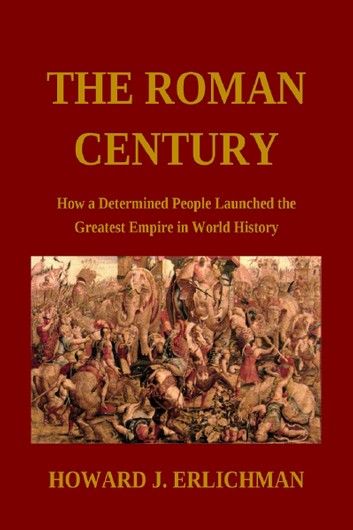 |
The Roman Century: How a Determined People Launched the Greatest Empire in World History 作者:Howard J. Erlichman 出版社:Howard J. Erlichman 出版日期:2015-10-01 語言:英文 |
 樂天KOBO
| 圖書館借閱 |
| 國家圖書館 | 全國圖書書目資訊網 | 國立公共資訊圖書館 | 電子書服務平台 | MetaCat 跨館整合查詢 |
| 臺北市立圖書館 | 新北市立圖書館 | 基隆市公共圖書館 | 桃園市立圖書館 | 新竹縣公共圖書館 |
| 苗栗縣立圖書館 | 臺中市立圖書館 | 彰化縣公共圖書館 | 南投縣文化局 | 雲林縣公共圖書館 |
| 嘉義縣圖書館 | 臺南市立圖書館 | 高雄市立圖書館 | 屏東縣公共圖書館 | 宜蘭縣公共圖書館 |
| 花蓮縣文化局 | 臺東縣文化處 |
|
|
The Roman Century: How a Determined People Launched the Greatest Empire in World History should be of interest to anyone who ponders the increasingly intense competition among the United States, China, Russia and emerging Islamic powers. The untimely death of Alexander the Great in 323 BC would not have caused anyone to predict that the 185-year-old Roman Republic was capable of outmaneuvering a number of powerful rivals -- Etruscans, Samnites, Celts, Epirotes, Carthaginians, Antigonids, Ptolemies and Seleucids -- and launching a multinational empire in 188 BC that would last, in its eastern form, until the fall of Constantinople in 1453.
The Roman federation of 323 was smaller in size than Los Angeles County, inhabited by less than 600,000 free citizens and woefully deficient in maritime affairs. Yet this modest regional enterprise proceeded in stepping-stone fashion to gain control of Central Italy (295), Southern Italy (272), Sicily (241), Sardinia (238) and large tributary slices of Spain (206), Tunisia (202), Macedon (197), Greece (191) and Anatolia (188) during the “long” 3rd century BC. The Romans advanced slowly and methodically. They borrowed ideas from their foes, masked their territorial ambitions with an innovative “protection-for-tribute” invasion model and generated a host of lessons to be studied by anyone interested in the processes through which overseas empires are won and lost.
The book is intended to serve as a very modern tale of military, economic and diplomatic history that just happens to be centered in the 3rd century BC. It explains how an unusually determined people adopted (and improved) a three-pronged blueprint of imperial conquest that had been laid-down by the Macedonians during the second half of the 4th century. The blueprint devised by Philip II and applied in grand fashion by his son Alexander combined brute military force, tributary finance and creative diplomacy into a new form of imperial power. But it was the Roman version, one infused with a fourth prong of pure resiliency, which ultimately launched (and sustained) the greatest empire in world history.
The Roman Century places the spectacular Roman advance in a much wider geo-political context than existing works; incorporates timeless observations from the likes of Appian, Arrian, Clausewitz, Diodorus, Livy, Machiavelli, Plutarch, Polybius, Sun Tzu and Thucydides; and describes the activities of some of the most remarkable warriors (and statesmen) of this or any age. All of this occurred nearly two centuries before Octavian (Augustus) Caesar became the first official Roman Emperor in 27 BC.
Howard J. Erlichman is also the author of Conquest, Tribute and Trade: How the Quest for Precious Metals Gave Birth to Globalization (2016/2010) and Camino del Norte: How a Series of Watering Holes, Fords and Dirt Trails Evolved into Interstate 35 in Texas (2006). He holds MS degrees from Harvard University and Rensselaer Polytechnic Institute and a BA in History (with Distinction) from Colby College.
|