| FindBook |
有 1 項符合
A Miscellany of Men的圖書 |
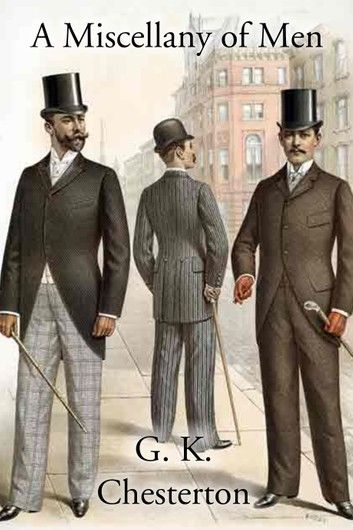 |
A Miscellany of Men 作者:G. K. Chesterton 出版社:CrossReach Publications 出版日期:2017-09-20 語言:英文 |
 樂天KOBO
| 圖書館借閱 |
| 國家圖書館 | 全國圖書書目資訊網 | 國立公共資訊圖書館 | 電子書服務平台 | MetaCat 跨館整合查詢 |
| 臺北市立圖書館 | 新北市立圖書館 | 基隆市公共圖書館 | 桃園市立圖書館 | 新竹縣公共圖書館 |
| 苗栗縣立圖書館 | 臺中市立圖書館 | 彰化縣公共圖書館 | 南投縣文化局 | 雲林縣公共圖書館 |
| 嘉義縣圖書館 | 臺南市立圖書館 | 高雄市立圖書館 | 屏東縣公共圖書館 | 宜蘭縣公共圖書館 |
| 花蓮縣文化局 | 臺東縣文化處 |
|
|
On the essays that follow, two comments may correctly be made: first, that they are written controversially; and second, that they are written badly. Two explanatory replies may be permitted. The first is that they were written at different times of a most crucial English epoch, from the South African War to the first impudences of Eugenics; a time in which the liberal tradition, as I hold it, was not only dying but committing suicide. The second is that I have never felt certain of my writing, but only quite certain of my opinions.
It is a curious question whether a man ought to write when he cannot write well. My own view of it is that in writing, as in singing or dancing or deer-stalking, he can do it—if he can do it. On this matter the modern world makes one enormous mistake. It remembers the mountain and the chasm; it forgets the vastness of the plain. It is true that the Irish Giant was very tall and that General Tom Thumb was very short: but it is quite untrue to suppose that men could be ranked in a smooth ascending slope, like the long side of some low pyramid from Tom Thumb up to the Giant. If all men could be induced to stand in a row for such a scientific comparison (which they could not, I am encouraged to believe) you would find a tall clump of rather tired Giants at one end, and a sudden drop into very vivacious dwarfs at the other: but between the two miles and miles, even hundreds of miles of a sort of rolling and slightly varying level, like Salisbury Plain. That all men are equal is a matter of abstract theory; that most men are equal is a matter of common fact. And as it is with altitude of stature, so it is with altitude in any one of the arts. At the one end there are a few who can do it perfectly; at the other end there are (I am told) a few who can only do it horribly or who cannot do it at all. Between the two stretch the interminable lines of that everlasting legion who can do it. There is such a thing as being able to read and write, being able to sow and reap, being able to play golf or read the Greek alphabet. And the difference between those who can do it and those who can’t do it is much more absolute and abysmal (to a true philosopher) than any difference in the degree of value or vileness with which it is done. I know, as every man knows, the things I can, in this literal sense, do. I can swim: I cannot ride. I can play chess: I cannot play bridge. I can scull: I cannot punt. I can read Greek lettering: I cannot read Arabic lettering. In this strong, sound, fundamental sense, I can write literature; whereas I could not write music. Or, if you like to put it so, I can’t play the piano, but I can play the fool. But the distinction is decisive. I can do it; and therefore I am a trader and not a thief. And I would sooner call myself a journalist than an author; because a journalist is a journeyman. He has a real working human trade; he even has a trade-union.
There is none of my idle observations that I feel less disposed to retract than one which has evoked some criticism: that if a thing is worth doing it is worth doing badly. And modern people (with their strange passion for superiorities and inferiorities) do not adequately realise that in this sense most things are done badly, even in the exalted or official spheres to which they look up with awe. They have a hazy idea that members of Parliament are more important, more mentally successful, than their constituents; that Cabinet Ministers are more brilliant and distinguished than other members of Parliament; that bishops, intellectually speaking, sit in a row on a bench above other clergymen; that judges sit in a row on a bench above other lawyers. But it is not so. We meet a really able man in law or politics exactly as we meet a really able man in an omnibus or an inn. There is nothing to be said about it, except that we are very lucky. Mr. Balfour and Mr. Birrell are really able men; Lord Morley and Mr. Wyndham are really able men. But one might as well judge all golfers by Mr. Balfour as judge all politicians by him. The ordinary Cabinet Minister, when he can administer at all, can administer simply in the sense that a plain cook can cook or a common soldier shoot. The ordinary statesman, when he can speak at all, can speak in the sense that a stone-breaker can break stones, or a housemaid can light a fire. That is, he is not half-witted; and he has learnt how the thing is done. And this is law and politics at their best; we shall be lucky if in the near future we do not find that our rulers of both factions have actually become more worthless than the people that they rule. Nevertheless, the curious illusion clings; and the people who sniff at amateurs in private life still manage to venerate absolute duffers in public life.
I think a medium and a moderation might be allowed; the Cabinet Minister taken a little less seriously and the cabinet-maker a little more. But I think there are normal things that a normal man ought to do, as he sleeps or wakes or walks. One of them is to sing, to a plain tune with a common chorus, as our fathers did round their supper tables. Another is to dance, however clumsily, at least some of the dances of his native land. Another is to speak with clearness and moderate cogency in any council of his equals or on any not disreputable public occasion. Another is to recite poetry if he likes it; another is to be at ease and tolerably intimate with domestic animals; another is to know, even slightly, the uses of some weapon; another is to know quite common remedies for quite common maladies. And another is to be able to write down in pen and ink what he really thinks about public questions, and why he thinks it: which is all that I have done in this place.
|