| FindBook |
有 1 項符合
When Good Jobs Go Bad的圖書 |
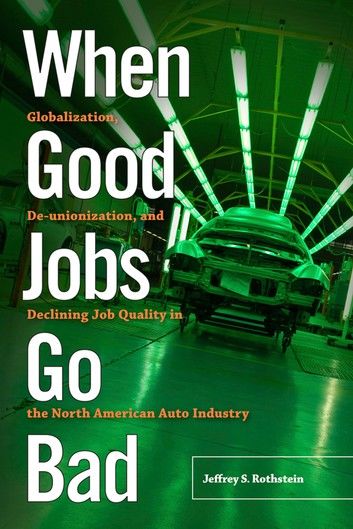 |
When Good Jobs Go Bad 作者:Jeffrey S. Rothstein 出版社:Rutgers University Press 出版日期:2016-03-16 語言:英文 |
 樂天KOBO
| 圖書館借閱 |
| 國家圖書館 | 全國圖書書目資訊網 | 國立公共資訊圖書館 | 電子書服務平台 | MetaCat 跨館整合查詢 |
| 臺北市立圖書館 | 新北市立圖書館 | 基隆市公共圖書館 | 桃園市立圖書館 | 新竹縣公共圖書館 |
| 苗栗縣立圖書館 | 臺中市立圖書館 | 彰化縣公共圖書館 | 南投縣文化局 | 雲林縣公共圖書館 |
| 嘉義縣圖書館 | 臺南市立圖書館 | 高雄市立圖書館 | 屏東縣公共圖書館 | 宜蘭縣公共圖書館 |
| 花蓮縣文化局 | 臺東縣文化處 |
|
|
From Chinese factories making cheap toys for export, to sweatshops in Bangladesh where name-brand garments are sewn—studies on the impact of globalization on workers have tended to focus on the worst jobs and the worst conditions. But in When Good Jobs Go Bad, Jeffrey Rothstein looks at the impact of globalization on a major industry—the North American auto industry—to reveal that globalization has had a deleterious effect on even the most valued of blue-collar jobs.
Rothstein argues that the consolidation of the Mexican and U.S.-Canadian auto industries, the expanding number of foreign automakers in North America, and the spread of lean production have all undermined organized labor and harmed workers. Focusing on three General Motors plants assembling SUVs—an older plant in Janesville, Wisconsin; a newer and more viable plant in Arlington, Texas; and a “greenfield site” (a brand-new, state-of-the-art facility) in Silao, Mexico—When Good Jobs Go Bad shows how global competition has made nonstop, monotonous, standardized routines crucial for the survival of a plant, and it explains why workers and their local unions struggle to resist. For instance, in the United States, General Motors forced workers to accept intensified labor by threatening to close plants, which led local unions to adopt “keep the plant open” as their main goal. At its new factory in Silao, GM had hand-picked the union—one opposed to strikes and committed to labor-management cooperation—before it hired the first worker.
Rothstein’s engaging comparative analysis, which incorporates the viewpoints of workers, union officials, and management, sheds new light on labor’s loss of bargaining power in recent decades, and highlights the negative impact of globalization on all jobs, both good and bad, from the sweatshop to the assembly line.
|