| FindBook |
有 1 項符合
John Archibald Campbell的圖書 |
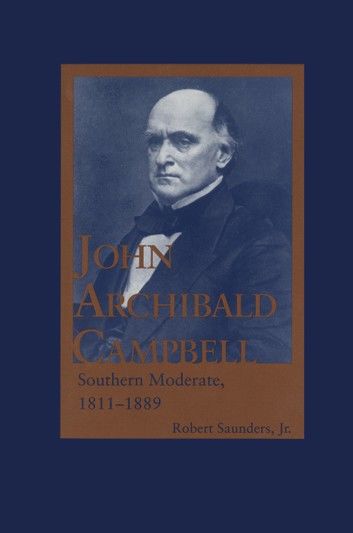 |
John Archibald Campbell 作者:Robert Saunders Jr 出版社:University of Alabama Press 出版日期:2017-05-16 語言:英文 |
 樂天KOBO
| 圖書館借閱 |
| 國家圖書館 | 全國圖書書目資訊網 | 國立公共資訊圖書館 | 電子書服務平台 | MetaCat 跨館整合查詢 |
| 臺北市立圖書館 | 新北市立圖書館 | 基隆市公共圖書館 | 桃園市立圖書館 | 新竹縣公共圖書館 |
| 苗栗縣立圖書館 | 臺中市立圖書館 | 彰化縣公共圖書館 | 南投縣文化局 | 雲林縣公共圖書館 |
| 嘉義縣圖書館 | 臺南市立圖書館 | 高雄市立圖書館 | 屏東縣公共圖書館 | 宜蘭縣公共圖書館 |
| 花蓮縣文化局 | 臺東縣文化處 |
|
|
Saunders presents the first full biography of the southern U.S. Supreme
Court justice who championed both the U.S. Constitution and states' rights.
The life of John Archibald Campbell reflects nearly every
major development of 19th-century American history. He participated either
directly or indirectly in events ranging from the Indian removal process
of the 1830s, to sectionalism and the Civil War, to Reconstruction and
redemption. Although not a defender of slavery, he feared that abrupt abolition
would produce severe economic and social dislocation. He urged southerners
to reform their labor system and to prepare for the eventual abolition
of slavery. In the early 1850s he proposed a series of reforms to strengthen
slave families and to educate the slaves so as to prepare them for assimilation
into society as productive citizens. These views distinguished him from
many southerners who steadfastly maintained the sanctity of the peculiar
institution.
Born and schooled in Georgia, Campbell moved to Montgomery,
Alabama, in the early 1830s, where he joined a successful law practice.
He served in the Alabama legislature for a brief period and then moved
with his family to Mobile to establish a law practice. In 1853 Campbell
was appointed an associate justice of the U.S. Supreme Court. His concurring
opinion in the Dred Scott case in 1857 derived not from the standpoint
of protecting slavery but from an attempt to return political power to
the states. As the sectional crisis gathered heat, Campbell counseled moderation.
He became widely detested in the North because of his defense of states'
rights, and he was distrusted in the South because of his moderate views
on slavery and secession. In May 1861 Campbell resigned from the Court
and later became the Confederacy's assistant secretary of war. After the
war, Campbell moved his law practice to New Orleans. Upon his death in
1889, memorial speakers in Washington, D.C., and New Orleans recognized
him as one of the nation's most gifted lawyers and praised his vast learning
and mastery of both the common law and the civil law.
In this first full biography of Campbell, Robert Saunders,
Jr., reveals the prevalence of anti-secession views prior to the Civil
War and covers both the judicial aspects and the political history of this
crucial period in southern history.
|