| FindBook |
有 2 項符合
The Evolution of Household Technology and Consumer Behavior, 1800–2000的圖書 |
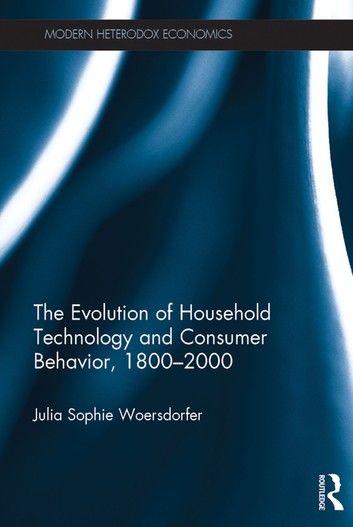 |
The Evolution of Household Technology and Consumer Behavior, 1800-2000 作者:Julia Sophie Woersdorfer 出版社:Taylor & Francis 出版日期:2017-03-27 語言:英文 |
 樂天KOBO
 博客來
博客來| 圖書館借閱 |
| 國家圖書館 | 全國圖書書目資訊網 | 國立公共資訊圖書館 | 電子書服務平台 | MetaCat 跨館整合查詢 |
| 臺北市立圖書館 | 新北市立圖書館 | 基隆市公共圖書館 | 桃園市立圖書館 | 新竹縣公共圖書館 |
| 苗栗縣立圖書館 | 臺中市立圖書館 | 彰化縣公共圖書館 | 南投縣文化局 | 雲林縣公共圖書館 |
| 嘉義縣圖書館 | 臺南市立圖書館 | 高雄市立圖書館 | 屏東縣公共圖書館 | 宜蘭縣公共圖書館 |
| 花蓮縣文化局 | 臺東縣文化處 |
|
|
The increasing division and specialization of labor between the market and the nonmarket sector is a central stylized fact of long-run economic development. Over time, a large share of activities which had formerly been carried out by the private household itself has become replaced by market alternatives, raising at the same time the demand for consumer goods.
The neoclassical economic framework of household production theory relates the increasing demand for household technology to rising wages and opportunity costs of time: the higher the wage rate, the more costly it is to spend time in unpaid housework activities. Consumer products are thus purchased to make household production processes more efficient and to substitute capital goods for the household’s time (time substitution hypothesis). Although this hypothesis sounds plausible at first sight, it cannot capture the essential phenomena underlying the complex process of the mechanization of the home over the past 200 years. Its major weakness lies in the treatment of consumer preferences, whose explanatory potential is explicitly factored out.
Using the washing of clothes as a microcosm of household economics, this book examines long-term changes in cleanliness consumption patterns from the perspective of an evolutionary economic, psychologically informed consumer theory. Woersdorfer shows how the historical evolution of cleanliness consumption over the past 200 years is the result of the interplay of supply and demand side factors, namely, technical change in washing technology on one side and motivational driving forces and consumer learning capabilities on the other. Hence, not changing relative prices but innate consumer needs and consumer learning processes, leading to a growing understanding of how to satisfy those needs, are the essential driving forces behind the rising technological endowment of the home and the corresponding demand for household appliances.
The Evolution of Household Technology and Consumer Behavior, 1800–2000 will be of interest to researchers in the field of evolutionary economics, historyof technology, economic history, innovation economics and sociology.
|