| FindBook |
有 1 項符合
The Nature of the Judicial Process的圖書 |
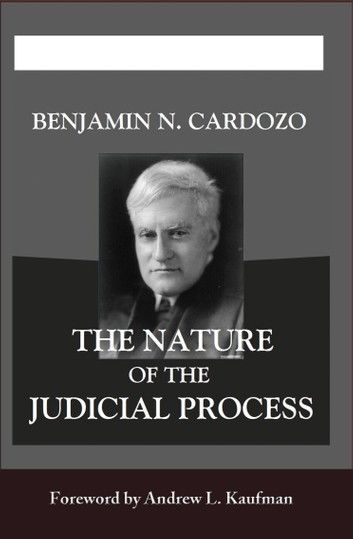 |
The Nature of the Judicial Process 作者:Andrew L. Kaufman(ed.) 出版社:Quid Pro, LLC 出版日期:2010-08-02 語言:英文 |
 樂天KOBO
| 圖書館借閱 |
| 國家圖書館 | 全國圖書書目資訊網 | 國立公共資訊圖書館 | 電子書服務平台 | MetaCat 跨館整合查詢 |
| 臺北市立圖書館 | 新北市立圖書館 | 基隆市公共圖書館 | 桃園市立圖書館 | 新竹縣公共圖書館 |
| 苗栗縣立圖書館 | 臺中市立圖書館 | 彰化縣公共圖書館 | 南投縣文化局 | 雲林縣公共圖書館 |
| 嘉義縣圖書館 | 臺南市立圖書館 | 高雄市立圖書館 | 屏東縣公共圖書館 | 宜蘭縣公共圖書館 |
| 花蓮縣文化局 | 臺東縣文化處 |
|
|
Justice Cardozo's classic study of law, precedent, and how judges think and decide cases. Features a modern, explanatory Foreword by Andrew L. Kaufman, the Harvard law professor recognized as Cardozo's premier biographer. Active Table of Contents, linked footnotes with correct numbers, photographs, and original pagination embedded for citing—like no other digital or online version of this important work. Not just scanned and forgotten, this edition is formatted with care and accuracy, and fully introduced, now brought to a new generation of readers.
Judges don’t discover the law, they create it. Benjamin Nathan Cardozo (1870-1938) offered the world a candid and self-conscious study of how judges decide cases and the law—they are lawmakers and not just law-appliers, he knew—all drawn from his insights and experience on the bench in a way that no judge had done before. Asked the basic questions, “What is it that I do when I decide a case? To what sources of information do I appeal for guidance?,” Cardozo answered them in his rich and timeless prose, explaining the proper use of such decisional tools as logic and analogy to precedent; analysis of history and tradition; application of public policy and sociology; and even the subconscious forces that drive judges' decisions. This book has had an impact on the introspective examination of courts in a way no other book has had, and it continues to be read today by lawyers and judges, law students and scholars, historians and and philosophers—among others interested in how judges really think and the tools they employ.
Judges are people, and lawmakers, too. “The great tides and currents which engulf the rest of men, do not turn aside in their course, and pass the judges by. We like to figure to ourselves the processes of justice as coldly objective and impersonal. The law, conceived of as a real existence, dwelling apart and alone, speaks, through the voices of priests and ministers, the words which they have no choice except to utter. ...It has a lofty sound; it is well and finely said; but it can never be more than partly true.” Beyond precedential cases and tradition, judges make choices, and they choose using methods of analysis and biases that ought to be examined.
Famous at the time for his trenchant and fluid opinions as a Justice on New York’s highest court (he is still studied on questions of torts, contracts, and business law) and later a Justice of the U.S. Supreme Court, Cardozo filled the lecture hall at Yale when he finally answered the frank query into what judges do and how do they do it. The lectures became a landmark book and a source for all other studies of the ways of a judge. Presented by Professor Kaufman as part of the Legal Legends Series of Quid Pro Books, this edition is the understandable and usable rendition of a classic work on law and politics.
Andrew L. Kaufman is the author of "Cardozo" (Harvard Univ. Press, 1998) and several law review articles on the life and times of Cardozo, on legal and judicial ethics, and on constitutional law. He is the Charles Stebbins Fairchild Professor of Law and Vice-Dean for Academic Programming at Harvard Law School. A former law clerk to Justice Felix Frankfurter, Kaufman is a graduate of Harvard College and Harvard Law School.
|