| FindBook |
有 1 項符合
Linear and Nonlinear Programming的圖書 |
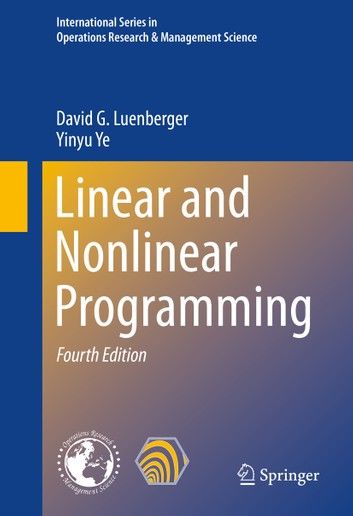 |
Linear and Nonlinear Programming 作者:Luenberger 出版社:Springer Verlag 出版日期:2008-07-07 語言:英文 規格:精裝 / 546頁 / 23.6 x 16 x 3.8 cm / 普通級/ 再版 |
 博客來
博客來| 圖書館借閱 |
| 國家圖書館 | 全國圖書書目資訊網 | 國立公共資訊圖書館 | 電子書服務平台 | MetaCat 跨館整合查詢 |
| 臺北市立圖書館 | 新北市立圖書館 | 基隆市公共圖書館 | 桃園市立圖書館 | 新竹縣公共圖書館 |
| 苗栗縣立圖書館 | 臺中市立圖書館 | 彰化縣公共圖書館 | 南投縣文化局 | 雲林縣公共圖書館 |
| 嘉義縣圖書館 | 臺南市立圖書館 | 高雄市立圖書館 | 屏東縣公共圖書館 | 宜蘭縣公共圖書館 |
| 花蓮縣文化局 | 臺東縣文化處 |
|
|
This new edition covers the central concepts of practical optimization techniques, with an emphasis on methods that are both state-of-the-art and popular. One major insight is the connection between the purely analytical character of an optimization problem and the behavior of algorithms used to solve a problem. This was a major theme of the first edition of this book and the fourth edition expands and further illustrates this relationship. As in the earlier editions, the material in this fourth edition is organized into three separate parts. Part I is a self-contained introduction to linear programming. The presentation in this part is fairly conventional, covering the main elements of the underlying theory of linear programming, many of the most effective numerical algorithms, and many of its important special applications. Part II, which is independent of Part I, covers the theory of unconstrained optimization, including both derivations of the appropriate optimality conditions and an introduction to basic algorithms. This part of the book explores the general properties of algorithms and defines various notions of convergence. Part III extends the concepts developed in the second part to constrained optimization problems. Except for a few isolated sections, this part is also independent of Part I. It is possible to go directly into Parts II and III omitting Part I, and, in fact, the book has been used in this way in many universities.
New to this edition is a chapter devoted to Conic Linear Programming, a powerful generalization of Linear Programming. Indeed, many conic structures are possible and useful in a variety of applications. It must be recognized, however, that conic linear programming is an advanced topic, requiring special study. Another important topic is an accelerated steepest descent method that exhibits superior convergence properties, and for this reason, has become quite popular. The proof of the convergence property for both standard and accelerated steepest descent methods are presented in Chapter 8. As in previous editions, end-of-chapter exercises appear for all chapters.
From the reviews of the Third Edition:
“… this very well-written book is a classic textbook in Optimization. It should be present in the bookcase of each student, researcher, and specialist from the host of disciplines from which practical optimization applications are drawn.” (Jean-Jacques Strodiot, Zentralblatt MATH, Vol. 1207, 2011)
|

![大大貓和小小貓[台灣限定珍藏版|附獨家授權限量周邊.大小貓貓追飯糰吊飾鑰匙圈]](https://cdn.kingstone.com.tw/book/images/product/20286/2028612414051/2028612414051m.jpg?v=a5ed1 "大大貓和小小貓[台灣限定珍藏版|附獨家授權限量周邊.大小貓貓追飯糰吊飾鑰匙圈]")