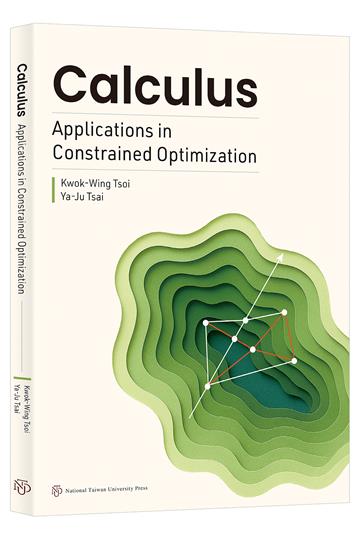
Calculus: Applications in Constrained Optimization provides an accessible yet mathematically rigorous introduction to constrained optimization, designed for undergraduate students who have some experiences with multivariable calculus. Based on a successful course at National Taiwan University (NTU) ── Calculus 4: Applications in Economics and Management, this book connects foundational calculus with contemporary techniques of optimization used in economics, management, and data science.
Classical tools such as Lagrange multipliers and second derivative tests are extended into a general framework that covers both equality and inequality constraints. Readers will also learn to identify degenerate cases and apply second-order conditions in multivariable settings. Key concepts from linear algebra are introduced and integrated throughout.
Each chapter concludes with a carefully structured set of exercises:
● Type (A) questions test basic understanding;
● Type (B) questions reinforce key examples;
● Type (C) questions challenge students to synthesise ideas across topics.
Whether used as a course text or for self-study, this book provides a concise, structured, and student-friendly guide to the essential ideas and methods of constrained optimization.
| FindBook |
有 5 項符合
Calculus:Applications in Constrained Optimization的圖書 |
 |
Calculus:Applications in Constrained Optimization 作者:Kwok-Wing Tsoi、Ya-Ju Tsai 出版社:國立臺大出版中心 出版日期:2025-08-11 語言:繁體/中文 |
| 圖書選購 |
| 型式 | 價格 | 供應商 | 所屬目錄 | $ 390 |
 iRead灰熊愛讀書 iRead灰熊愛讀書 |
政府出版品 |
$ 395 |
 TAAZE 讀冊生活 TAAZE 讀冊生活 |
中文書 |
$ 395 |
 博客來 博客來 |
數學 |
$ 450 |
 五南文化廣場網路書店 五南文化廣場網路書店 |
教育學習 |
$ 475 |
 金石堂 金石堂 |
大學出版品 |
|---|
| 圖書館借閱 |
| 國家圖書館 | 全國圖書書目資訊網 | 國立公共資訊圖書館 | 電子書服務平台 | MetaCat 跨館整合查詢 |
| 臺北市立圖書館 | 新北市立圖書館 | 基隆市公共圖書館 | 桃園市立圖書館 | 新竹縣公共圖書館 |
| 苗栗縣立圖書館 | 臺中市立圖書館 | 彰化縣公共圖書館 | 南投縣文化局 | 雲林縣公共圖書館 |
| 嘉義縣圖書館 | 臺南市立圖書館 | 高雄市立圖書館 | 屏東縣公共圖書館 | 宜蘭縣公共圖書館 |
| 花蓮縣文化局 | 臺東縣文化處 |
|
|
圖書介紹 - 資料來源:博客來 評分:
圖書名稱:Calculus:Applications in Constrained Optimization
內容簡介
作者介紹
作者簡介
Kwok-Wing Tsoi(蔡國榮)
Kwok-Wing Tsoi is a Project Assistant Professor (Teaching) in the Department of Mathematics at National Taiwan University, where he plays a pivotal role in the development and instruction of foundational mathematics courses. He received his Ph.D. in algebraic number theory from King’s College London in 2018. In recognition of his dedication to teaching, he has been honored with the King’s Education Award (2019) and the NTU Distinguished Teaching Award (2021).
Ya-Ju Tsai(蔡雅如)
Ya-Ju Tsai is a Project Assistant Professor (Teaching) in the Department of Mathematics at National Taiwan University. She earned her Ph.D. in harmonic analysis from the University of California, Los Angeles in 2005. She serves as the chief coordinator of the university-wide unified calculus courses and has over a decade of teaching experience. Her contributions to education have been recognized with the NTU Distinguished Teaching Award (2024).
Kwok-Wing Tsoi(蔡國榮)
Kwok-Wing Tsoi is a Project Assistant Professor (Teaching) in the Department of Mathematics at National Taiwan University, where he plays a pivotal role in the development and instruction of foundational mathematics courses. He received his Ph.D. in algebraic number theory from King’s College London in 2018. In recognition of his dedication to teaching, he has been honored with the King’s Education Award (2019) and the NTU Distinguished Teaching Award (2021).
Ya-Ju Tsai(蔡雅如)
Ya-Ju Tsai is a Project Assistant Professor (Teaching) in the Department of Mathematics at National Taiwan University. She earned her Ph.D. in harmonic analysis from the University of California, Los Angeles in 2005. She serves as the chief coordinator of the university-wide unified calculus courses and has over a decade of teaching experience. Her contributions to education have been recognized with the NTU Distinguished Teaching Award (2024).
目錄
Preface
Acknowledgment
Introduction
1 Linear Algebra (I): Vocabulary
1.1 Vector space Rn and its properties
1.2 Subspaces of Rn
1.3 Linear independence
1.4 Basis and dimension
1.5 Inner product of Rn
1.6 Gram-Schmidt process
1.7 Exercises for Chapter 1
2 Linear Algebra (II): Ranks
2.1 Review on matrices
2.2 Solving equations by Gaussian eliminations
2.3 Applications of Gaussian eliminations
2.4 Rank
2.5 Determinant
2.6 Inverse
2.7 Exercises for Chapter 2
3 Linear Algebra (III): Definiteness
3.1 Some special matrices
3.2 Motivation: Complete the squares
3.3 Eigenvalues and eigenvectors
3.4 Diagonalization of symmetric matrices
3.5 Definiteness
3.6 Sylvester's criterion
3.7 Connection with quadratic forms
3.8 Second derivative test and generalization
3.9 Proof of Sylvester's criterion
3.10 Exercises for Chapter 3
4 Constrained Optimization (I)
4.1 Optimization: Equality constraints
4.2 Non-degenerate constraint qualifications (NDCQ)
4.3 Worked example: Equality constraints
4.4 Optimization: Inequality constraints
4.5 NDCQ for inequality constrained problems
4.6 Proof of complementary slackness
4.7 Proof of non-negativity of multipliers
4.8 Worked example: Inequality constraints
4.9 Worked examples: Linear programming on R2
4.10 Exercises for Chapter 4
5 Constrained Optimization (II)
5.1 Optimization: Mixed constraints
5.2 Worked examples: Mixed constraints
5.3 Optimization: Minimization problems
5.4 Worked example: Minimization problems
5.5 Optimization: Kuhn-Tucker's formulation
5.6 Proof of Kuhn-Tucker's FOC
5.7 NDCQ in Kuhn-Tucker's formulation
5.8 Worked examples : Kuhn-Tucker's formulation
5.9 Exercises for Chapter 5
6 Envelope Theorems
6.1 Motivation: Linear budget constraint problem
6.2 Envelope Theorem for equality constraints
6.3 Worked example: Envelope Theorem
6.4 Applications: Shadow prices
6.5 Envelope Theorem for unconstrained problems
6.6 Envelope Theorem for inequality constraints
6.7 Applications in Economics
6.8 Proofs of Envelope Theorems
6.9 Exercises for Chapter 6
7 Second Order Conditions
7.1 Motivation : Bordered Hessian matrices
7.2 Bordered Hessian matrices
7.3 Second order conditions: Statement
7.4 Worked examples: Second order conditions
7.5 Second derivative test for unconstrained problems
7.6 Sketch of the proofs of SOC
7.7 Exercises for Chapter 7
Appendix. Di!erential Calculus
A. Partial derivatives
B. Chain rule for multivariable functions
C. Elementary results of optimization in multivariable
Answers to Selected Exercises
Bibliography
Index
Acknowledgment
Introduction
1 Linear Algebra (I): Vocabulary
1.1 Vector space Rn and its properties
1.2 Subspaces of Rn
1.3 Linear independence
1.4 Basis and dimension
1.5 Inner product of Rn
1.6 Gram-Schmidt process
1.7 Exercises for Chapter 1
2 Linear Algebra (II): Ranks
2.1 Review on matrices
2.2 Solving equations by Gaussian eliminations
2.3 Applications of Gaussian eliminations
2.4 Rank
2.5 Determinant
2.6 Inverse
2.7 Exercises for Chapter 2
3 Linear Algebra (III): Definiteness
3.1 Some special matrices
3.2 Motivation: Complete the squares
3.3 Eigenvalues and eigenvectors
3.4 Diagonalization of symmetric matrices
3.5 Definiteness
3.6 Sylvester's criterion
3.7 Connection with quadratic forms
3.8 Second derivative test and generalization
3.9 Proof of Sylvester's criterion
3.10 Exercises for Chapter 3
4 Constrained Optimization (I)
4.1 Optimization: Equality constraints
4.2 Non-degenerate constraint qualifications (NDCQ)
4.3 Worked example: Equality constraints
4.4 Optimization: Inequality constraints
4.5 NDCQ for inequality constrained problems
4.6 Proof of complementary slackness
4.7 Proof of non-negativity of multipliers
4.8 Worked example: Inequality constraints
4.9 Worked examples: Linear programming on R2
4.10 Exercises for Chapter 4
5 Constrained Optimization (II)
5.1 Optimization: Mixed constraints
5.2 Worked examples: Mixed constraints
5.3 Optimization: Minimization problems
5.4 Worked example: Minimization problems
5.5 Optimization: Kuhn-Tucker's formulation
5.6 Proof of Kuhn-Tucker's FOC
5.7 NDCQ in Kuhn-Tucker's formulation
5.8 Worked examples : Kuhn-Tucker's formulation
5.9 Exercises for Chapter 5
6 Envelope Theorems
6.1 Motivation: Linear budget constraint problem
6.2 Envelope Theorem for equality constraints
6.3 Worked example: Envelope Theorem
6.4 Applications: Shadow prices
6.5 Envelope Theorem for unconstrained problems
6.6 Envelope Theorem for inequality constraints
6.7 Applications in Economics
6.8 Proofs of Envelope Theorems
6.9 Exercises for Chapter 6
7 Second Order Conditions
7.1 Motivation : Bordered Hessian matrices
7.2 Bordered Hessian matrices
7.3 Second order conditions: Statement
7.4 Worked examples: Second order conditions
7.5 Second derivative test for unconstrained problems
7.6 Sketch of the proofs of SOC
7.7 Exercises for Chapter 7
Appendix. Di!erential Calculus
A. Partial derivatives
B. Chain rule for multivariable functions
C. Elementary results of optimization in multivariable
Answers to Selected Exercises
Bibliography
Index
序
Preface
Constrained optimization is a critical and contemporary subject across many disciplines. For example, many principles in classical economical theory are developed based on optimization theory to allocate scarce resources optimally. More recently, theory in optimization has been developed rapidly to catch up with the recent trend of Artificial Intelligence and Machine Learning. The increasing demand for knowledge in optimization led the Department of Mathematics at National Taiwan University to offer an 32-hour elective course on constrained optimization (titled ‘Calculus 4 – Applications in Economics and Management’) in the spring of 2019. The course is intended for students who have just finished courses in classical multivariable (differential) calculus.
The aforementioned course aims to extend and refine the elementary forms of the second derivative test for functions of two variables and the method of Lagrange multipliers for problems with equality constraints, as introduced in students’ earlier courses. To give a little more detail, these ideas were further developed to handle optimization problems involving both equality and inequality constraints, to identify degenerate points arising from such constraints, to derive Envelope Theorems that capture the sensitivity of the optimal value with respect to variations in the constraints and to formulate second-order conditions for constrained optimization problems in spaces of arbitrary dimension. The course has been well-received by both students and faculty members.
To achieve this goal, we will require a substantial background from linear algebra which is the formal language and theory of vectors and matrices. These concepts will be introduced in the beginning. Indeed, optimization theory is one of the many instances in mathematics where (linear) algebra and calculus intersect and enrich each other. The tools of both disciplines work in harmony to deepen our understanding of constrained optimization problems.
Although much literature and textbooks already exist on the subject, most are either too advanced or, at the other extreme, lack sufficient mathematical rigor. This book aims to introduce the basics of optimization theory in an intuitive manner that is accessible to undergraduate students who have acquired a standard course in multivariable differential calculus while maintaining some level of mathematical rigor. The authors believe that understanding both applications and mathematical foundations of optimization theory is crucial for preparing students of this generation, correctly, for more advanced courses and future challenges.
Constrained optimization is a critical and contemporary subject across many disciplines. For example, many principles in classical economical theory are developed based on optimization theory to allocate scarce resources optimally. More recently, theory in optimization has been developed rapidly to catch up with the recent trend of Artificial Intelligence and Machine Learning. The increasing demand for knowledge in optimization led the Department of Mathematics at National Taiwan University to offer an 32-hour elective course on constrained optimization (titled ‘Calculus 4 – Applications in Economics and Management’) in the spring of 2019. The course is intended for students who have just finished courses in classical multivariable (differential) calculus.
The aforementioned course aims to extend and refine the elementary forms of the second derivative test for functions of two variables and the method of Lagrange multipliers for problems with equality constraints, as introduced in students’ earlier courses. To give a little more detail, these ideas were further developed to handle optimization problems involving both equality and inequality constraints, to identify degenerate points arising from such constraints, to derive Envelope Theorems that capture the sensitivity of the optimal value with respect to variations in the constraints and to formulate second-order conditions for constrained optimization problems in spaces of arbitrary dimension. The course has been well-received by both students and faculty members.
To achieve this goal, we will require a substantial background from linear algebra which is the formal language and theory of vectors and matrices. These concepts will be introduced in the beginning. Indeed, optimization theory is one of the many instances in mathematics where (linear) algebra and calculus intersect and enrich each other. The tools of both disciplines work in harmony to deepen our understanding of constrained optimization problems.
Although much literature and textbooks already exist on the subject, most are either too advanced or, at the other extreme, lack sufficient mathematical rigor. This book aims to introduce the basics of optimization theory in an intuitive manner that is accessible to undergraduate students who have acquired a standard course in multivariable differential calculus while maintaining some level of mathematical rigor. The authors believe that understanding both applications and mathematical foundations of optimization theory is crucial for preparing students of this generation, correctly, for more advanced courses and future challenges.
|