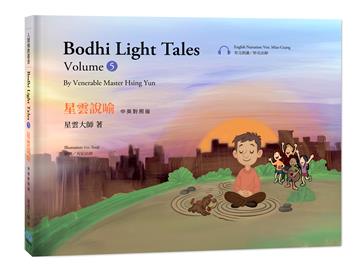
觸動心靈的寓言故事 小時候,故事書經常是陪伴我們長大的忠實良伴,在成長的過程中引領著我們。好的故事會觸動心靈,並且啟發我們要讓自己和周遭的世界變得更好。故事,也會形塑我們的價值觀,而我們最終成為什麼樣的人將取決於這些價值觀。 星雲大師著《星雲說喻 中英對照版》一共六冊,讓讀者透過閱讀生動有趣的故事,探索並領悟佛陀深奧的教法和人間佛教理念。故事圍繞著佛教的「六度波羅蜜」開展,也就是菩薩道的「六度」精神:布施、持戒、忍辱、精進、禪定和般若。每篇故事以一則智慧法語作為總結,引導讀者省思個中寓意。這些故事如同一面明鏡,帶著我們檢視生活,思維如何將那永恆不朽的佛法應用在生活。 第五冊收錄十五篇以六度波羅蜜中的「禪定」為主題的短篇故事。這是一套適合所有年齡層讀者的故事選集,本套書亦提供中英詞彙表,雙語讀者能更好理解每則故事的精髓。 期許《星雲說喻 中英對照版》能帶領讀者探索故事中無窮的慈悲、智慧與布施精神,照亮生命的道路。 Since our earliest days, stories have been faithful companions, guiding us through life’s journey. The power of a good story lies in its ability to touch our hearts, inspiring us to grow and bring positive change to ourselves and the world around us. Stories shape our perspective, and in turn, our perspective shapes who we become. Introducing Bodhi Light Tales by Venerable Master Hsing Yun, a monumental 6-volume set available in both English and Chinese. This enchanting collection invites readers to explore the profound teachings of the Buddha and the principles of Humanistic Buddhism. Stories centered around the Six Paramitas, also known as the Six Perfections: Generosity, Precept, Patience, Diligence, Meditative Concentration, and Wisdom. Each tale in this collection is accompanied by words of wisdom, offering profound insights that encourage reflection upon the moral lessons conveyed. These stories provide a mirror through which we can examine our own lives and contemplate how these timeless teachings can be applied to our daily existence. In this fifth volume, you will immerse yourself in the realm of Meditative Concentration through a treasury of 15 short stories. Designed to captivate readers of all ages, this book also includes vocabulary lists to assist bilingual readers in fully understanding the essence of each tale. May Bodhi Light Tales illuminate your path as you explore the boundless possibilities of compassion, understanding, and generosity.
Biography of Venerable Master Hsing Yun Venerable Master Hsing Yun was born in 1927 in Jiangdu, Jiangsu Province, China. At the age of 12, he was tonsured by Venerable Master Zhikai in Qixia Temple, Nanjing, with Dajue Temple in Yixing, Jiangsu, as his ancestral temple. He later became the 48th-generation lineage holder of the Linji Chan school. In 1947, he graduated from Jiaoshan Buddhist College, and also trained at various Chan, Pure Land, and Vinaya monasteries, including Jinshan, Qixia, and others. He received a comprehensive Buddhist education in the lineage, teachings, and Vinaya disciplines. Later on, the Venerable Master was invited to serve as the principal of Baita Elementary School, and also the editor-in-chief of Raging Billows Monthly. In the spring of 1949, the Venerable Master arrived in Taiwan. He served as the editor-in-chief of Human Life Magazine, Buddhism Today Magazine, and Awakening the World. In 1967, the Venerable Master founded the Fo Guang Shan Buddhist Order, with the Four Objectives: to propagate the Dharma through culture; to foster talents through education; to benefit society through charity, and to purify people’s minds through spiritual cultivation. Guided by the principles of Humanistic Buddhism, he went on to establish over three hundred temples worldwide. Additionally, he oversaw the creation of various art galleries, libraries, publishing companies, bookstores, the Merit Times newspaper, and the Cloud and Water Mobile Clinic. Furthermore, he established sixteen Buddhist colleges and founded three high schools and five universities, including the University of the West in the United States, Fo Guang University in Taiwan, Nanhua University in Taiwan, Nan Tien Institute in Australia, and Guang Ming College in the Philippines. Notably, he also established the Institute of Humanistic Buddhism. In 1970, the Venerable Master established Da Ci Children’s Home and the Lanyang Ren Ai Senior Citizen’s Home, providing shelter and care for vulnerable young children, and elderly individuals. He also actively engaged in emergency relief efforts, contributing to the fostering of a welfare society. Then, in 1991, he founded the Buddha’s Light International Association (BLIA) and was elected as the President of the World Headquarters. Under his guidance, the association’s mission expanded, symbolized by the saying, “the Buddha’s Light shining over three thousand realms, and the Dharma water flowing continuously through the five continents. In 1977, the Fo Guang Buddhist Canon, the Fo Guang Dictionary of Buddhism, and the 132-volume Selected Chinese Buddhist Texts in Modern Language were compiled. In 2017, the Complete Works of Venerable Master Hsing Yun was published, comprising 365 volumes with over 30 million words. In 2023, it was supplemented to 395 volumes, exceeding 40 million words, systematically expounding the ideologies, teachings, theories, and practical outcomes of Humanistic Buddhism. In 2023, the Venerable Master peacefully passed away, his virtuous deeds complete and fulfilled, having reached the age of ninety-seven. He was revered as the Founding Master of the Fo Guang Order, and he left behind this poignant poem:
A mind with the compassionate vow to deliver sentient beings, A body like a boat on the Dharma ocean, unbound. Should you ask what I have achieved in this lifetime? Peace and happiness shine upon the five continents.
章節試閱
The Peaceful Orchids 禪師與蘭花 金代禪師很喜歡蘭花,他種了許多名貴品種的蘭花,細心呵護,視之如命。有一天他要外出,囑咐徒弟們要好好照顧蘭花。不料,有一次在澆水時,其中一個徒弟不小心絆倒了蘭花架,霎時,如大珠小珠落地,瓦破花碎,一片狼藉。闖禍的徒弟,手足無措,不知如何是好! 金代禪師回來時,這個徒弟趕快跪在師父的面前懺悔:「師父,我把您心愛的蘭花摔得支離破碎,我願意接受任何的處罰,請求師父慈悲,不要生氣!」
Once upon a time, there lived a Chan Master named Jin Dai. He loved orchids and planted all sorts of different types. When his time was not occupied1 by giving Buddhist talks, he would spend time taking care of his flowers, because they were as important to him as his own life. One day, he had to make a trip out of town for a Dharma Service2 and would not be back for a few days. He worried that while he was gone, his orchids would be left unattended3. And so, he specifically asked one of his disciples to take good care of his orchids. After giving instructions4 to this Disciple, he left the monastery to attend the Dharma Service. As instructed by his Master, the Disciple watered the orchids every day. On a particular day, as the Disciple was watering the orchids, he found there were bees in the orchids. And he panicked5 and jumped backward, which caused him to knock down a whole row of orchid pots. The pots fell to the ground,shattering6 into pieces. The Disciple felt so terrible, and did not know what else to do but to wait until his Master returned and owned up to his mistake. The next day, when the Chan Master returned from his trip, the Disciple went to him and confessed7, “Master, I am so sorry that I have ruined your beloved orchids. Please punish me, and I will willingly accept. I beg for your compassion and please don’t be furious8 with me!” The Chan Master, upon hearing his disciple’s plea9, remained tranquil10 and calm. He responded, “Indeed, the orchids are beautiful and I love them very much. However, I planted them for two reasons: One is to make offerings to the Buddhas, and two is to make our surroundings more beautiful. I most certainly did not plant these orchids in order to get angry.” This story highlights an important message, that is, we have not come into this world to get angry, nor have we come to this world to accumulate11 worries. This is a good reminder. If we can remember the Chan Master’s attitude of “I have not planted the orchids just to get angry.” Then we can avoid misunderstandings and conflicts12 in our interpersonal13 relationships, such as with our parents, friends, colleagues, and family. If we have joy in our hearts, everywhere we go is pleasant. If we have Chan in our hearts, every sound we hear is poetic. If we have the Buddha in our hearts, every person and situation we meet is with kindness. “We have not come into this world just to get angry.” This can be useful to change our perspectives14 when we are feeling down, as it can open us to spiritual15 joy, peace, and happiness. In Buddhist practices, offerings to the Buddha, Dharma, and Sangha are typically with objects such as a lit candle, burning incense, flowers, food, fruit, water, and many more. Flowers are used as offerings because they are the most beautiful things in the world. When we offer flowers to the Buddhas, Dharma, and Sangha, we do so with utmost sincerity16. And when the flowers fade, it is also a reminder that all things in this world also fade in time. This is a teaching of “whatever is of the nature to arise is also of the nature to cease17,” this is also known as the law of impermanence18.
星雲大師法語 Dharma Words by Venerable Master Hsing Yun 花的美麗,要將美麗的善心散滿人間。 花的芬芳,要將芬芳的愛心傳播社會。 花的清淨,要將清淨的真心供養十方。 花的彩色,要將彩色的好心與人結緣。
Like the beauty of a flower, spread the beauty of your heart to everyone. Like the fragrance of a flower, spread the fragrance of your love to everyone. Like the purity of a flower, offer the purity of your heart to everyone. Like the color of a flower, make good affinities with your good heart.
A Simple Change of Mind 哭婆與笑婆 某個村子裡有位愛哭的老太太,每天哭哭啼啼。因為她有兩個女兒,大女兒嫁給賣雨傘店的人家,小女兒嫁給米粉店的老闆。天氣晴朗時,她總是掛念大女兒的雨傘賣不出去;遇到下雨天,她開始為小女兒著急,萬一米粉沒有太陽晒,發霉了怎麼辦?於是出太陽時,她為雨傘店的大女兒哭;下雨了,她為米粉店的小女兒哭。不論是晴是雨,老太太都要哭,因此,人人叫她「哭婆」。
Once upon a time in a village, there was an old woman who cried all the time. Every day, she could be heard weeping1. On sunny days, villagers would hear her sobbing2. And on rainy days, tears3 would flow down her cheeks4. Soon, she became known to all as the “Crying Woman.” And the reason she was always crying was because of her two daughters. The eldest daughter was married to an umbrella maker and the youngest to a noodle maker. The umbrella maker sold many umbrellas on rainy days as everybody needed one and thus the family was happy as they made much profit5. But on those days the noodles never dried and the noodle maker would have nothing to sell. So, on rainy days the Crying Woman would weep for her younger daughter’s family. On the other hand, noodles sold best on sunny days, as the shining sun quickly dried them. So, on these days the youngest daughter’s family was happy as they made much profit. But on these days, the cloudless skies and shining sun meant no umbrellas were sold. So, whenever the sun shone, The Crying Woman would be weeping for her eldest daughter’s family. One day, the Crying Woman met a Buddhist monk. Weary from constant sorrow6, she asked if he could help her. The monk listened to her story, and after a moment of reflection7, smiled and replied, “You cannot control the weather and you cannot control how it affects8 your family. But what you can control is your mind and your way of thinking. Remember, all good or bad in this world is dependent9 on your mindset10 and point of view, just as wisdom and foolishness are two sides of the same coin. From now on, when you see the sun, think about the happiness of your younger daughter and her family, for they sell many noodles. When it rains, think about the happiness of your eldest daughter and her family, for they will sell many umbrellas. Choosing to see the positive rather than the negative will make you happy and you need no longer worry and cry.” So, by changing her way of thinking, the Crying Woman turned from being miserable11 to cheerful12, smiling at everyone and everything. Now, she knew that no matter rain or shine, one of her daughters and families would be content13. The moral of the story is that, if we try to find comfort14 in constantly changing things, we can never find peace of mind15. We may not be able to change nature or weather. But what we can change is our perspective. The Crying Woman who became the Happy Woman is one and the same. She may not have influence over the weather that comes and goes, but she was able to calm the storm within her. Just as said in a Buddhist sutra, “Relying on causes and conditions gives us nothing real16; It is like a candle in the wind and bubbles on the water.” Remember, all you need is a simple change of mind. VOCABULARY 1. weeping (v.) 哭泣 2. sobbing (v.) 啜泣 3. tears (n.) 眼淚 4. cheeks (n.) 臉頰 5. profit (n.) 利潤 6. sorrow (n.) 悲傷 7. reflection (n.) 沉思 8. affects (v.) 影響 9. dependent (adj.) 隨……而定的 10. mindset (n.) 思維方式;心態 11.miserable (adj.) 痛苦的 12.cheerful (adj.) 快樂的 13.content (adj.) 滿足的;知足的 14.comfort (n.) 安慰 15.peace of mind (phr.) 安心 16.real (adj.) 真實的
星雲大師法語 Dharma Words by Venerable Master Hsing Yun 心中有歡喜的人,到處是賞心悦目的景色; 心中有襌定的人,耳聞是八萬四千的詩偈; 心中有佛法的人,面對是善人善緣的世界。
For people who have joy in their minds, everywhere is a landscape that delights the heart and pleases the eye. For people who have meditative concentration in their minds, what they hear are innumerable poems. For people who have the Dharma in their minds, what they face is a world of good people and good affinity.
The Peaceful Orchids 禪師與蘭花 金代禪師很喜歡蘭花,他種了許多名貴品種的蘭花,細心呵護,視之如命。有一天他要外出,囑咐徒弟們要好好照顧蘭花。不料,有一次在澆水時,其中一個徒弟不小心絆倒了蘭花架,霎時,如大珠小珠落地,瓦破花碎,一片狼藉。闖禍的徒弟,手足無措,不知如何是好! 金代禪師回來時,這個徒弟趕快跪在師父的面前懺悔:「師父,我把您心愛的蘭花摔得支離破碎,我願意接受任何的處罰,請求師父慈悲,不要生氣!」
Bodhi Light Tales is a captivating 6-volume collection of stories focused on the Six Paramitas, narrated by the revered Venerable Master Hsing Yun. Originally published in Chinese as Xingyun shuoyu (星雲說喻), these Buddhist Tales by Venerable Master Hsing Yun emerged from his enlightening talks and lectures on Humanistic Buddhism. In 2019, we took the initiative to adapt these stories into English as an ongoing audiobook series for the Bodhi Light Tales Anchor Podcast channel. However, our ultimate vision has always been to present them in a book format. As the original stories were concise and lacked additional details, the English adaptations were intentionally modified from the Chinese. In essence, the English tales are not direct translations of their original Chinese counterparts. To ensure that readers of all ages, faiths, beliefs, and cultures can connect with these stories, we employed several key approaches during the transition from Chinese to English, which we will elaborate on below. To make the main characters more relatable, we added background information such as their names, occupations, and personalities. Thorough research was conducted to maintain historical and factual accuracy. We hope this additional information will help readers delve deeper into their favorite characters and even encourage further exploration. Additionally, we made certain adaptations to accommodate language differences. For instance, in one of the stories, one single plane mentioned at first transformed into eleven planes, and in the end, ninety-one planes. In the English version, we changed it to nine planes as mentioned initially, later becoming nineteen planes, and finally, ninety planes. These modifications were implemented to preserve the example of homophones originally featured, ensuring comprehension for English readers. Additionally, we included Dharma Words from Venerable Master Hsing Yun at the end of each story, offering readers a final nugget of wisdom to take away. These quotes were carefully selected based on their relevance to the moral of each story. Venerable Master Hsing Yun originally shared these words of encouragement and advice based on his life experiences, aiming to inspire mindfulness and guide individuals in times of uncertainty. Remember, Buddha-nature resides within all of us, regardless of whether we practice Buddhism or not. Both children and adults have the power to better themselves and positively impact the world around them. Our sincere hope is that these stories will inspire people of all ages, instilling in them a sense of inspiration, courage, and compassion. May this collection serve as a source of inspiration as you navigate through life’s journey toward self-awakening!
Bodhi Light Tales:Volume 5 Biography of Venerable Master Hsing Yun 星雲大師簡介 Editor’s Introduction 編者序 How to Use This Book 如何使用本書
Stories 01. Finding Our Long Lost Mind 找回遺忘的性靈 02. The Mind of Chan 沙彌的禪機 03. Cultivation Starts from the Mind 佛與牛糞 04. Watching the Door 把門守好 05. The Blind Lamp 瞎子打燈籠 06. The Peaceful Orchids 禪師與蘭花 07. Devil's Mask 鬼殼的面具 08. The Happy Suit 西裝的快樂 09. A Simple Change of Mind 哭婆與笑婆 10. Fruit Portrait 水果上的肖像 11. Chilling Out in the Poop 大便裡乘涼 12. Kill It with Laughter 大笑可以治病 13. Five-Dollar Silence 唱歌五塊錢 14. Flowers or Fish? 香花與臭魚 15. Barks of Life 小狗汪汪叫
Bodhi Light Tales:Volume 5 Biography of Venerable Master Hsing Yun 星雲大師簡介 Editor’s Introduction 編者序 How to Use This Book 如何使用本書
Stories 01. Finding Our Long Lost Mind 找回遺忘的性靈 02. The Mind of Chan 沙彌的禪機 03. Cultivation Starts from the Mind 佛與牛糞 04. Watching the Door 把門守好 05. The Blind Lamp 瞎子打燈籠 06. The Peaceful Orchids 禪師與蘭花 07. Devil's Mask 鬼殼的面具 08. The Happy Suit 西裝的快樂 09. A Simple Change of Mind 哭婆與笑婆 10. Fruit Portrait 水果...