Chapter 1 From Conference Hero to Journal Zero
You remember the feeling of seeing your name in the conference program, your PowerPoint slides ready, your voice shaking just a little less than usual. You step onto that conference stage and feel like a rising star. But here’s what no one tells you: just because you presented your research doesn’t mean you’ve published it. In fact, the applause from your conference might just be the first hook. The real test begins after you leave the podium, when your advisor looks you in the eye and says, “Now turn it into a journal article.” What comes next? Confusion, rewrites, ego bruises, and eventually… growth. Welcome to your first real taste of academic publishing.
Episode 1: Conference Glory
Scene 1: A strong confidence booster
Back in the spring of 2017, I had the opportunity to attend my second international conference. Only this time, it was held in the United States. To be honest, I hadn’t expected to get in. My professors often talked about how prestigious this conference was, making it sound like an impossible feat. But, against all odds, my submission was accepted. Since I had never faced a rejection in conference submissions before, my confidence soared. It felt like I was Iron Man in the first movie, standing tall with his arm raised as his Stark Industries weapons fired in the background. Conference acceptance can feel like a huge achievement, but it’s only the beginning.
On the last day of the conference, a Japanese researcher approached me and complimented my study. She also told me I spoke lovely English. I smiled modestly and brushed it off, but deep down, I wasn’t sure if she was more impressed by my research or my English pronunciation. Either way, I spent five days absorbing knowledge from experts around the world, then took some time to explore America. It was the perfect mix of academic inspiration and light tourism. I returned to Taiwan feeling rejuvenated, ready to share my experience with my advisor.
Now, my advisor, Professor Elliot, was a seasoned professor, someone who had probably attended more conferences than I had family gatherings. As I sat in his office, excitedly recounting and sharing my conference experience, he listened with a reassuring smile, waiting for me to finish.
“Ted, this is great stuff. You’ve now been to two conferences. It’s time for you to take the next step.”
I nodded, waiting for him to drop the next piece of wisdom.
Scene 2: Manuscripts, roll out! – Academic transformers
“It’s time for you to turn your study into something worthy of a journal.”
“Oh, okay. That sounds like a plan,” I said, trying to sound confident. Inside, my brain was like, “Sure... what does that even mean?”
At the time, I had no idea that this was where the real struggle began. Conferences were one thing, but journal writing? That was an entirely different arena.
“So, professor, which journal should I send my paper to?” I asked.
“Hold on now, let’s not get ahead of ourselves. You don’t have a paper yet,” he said, leaning back in his chair.
I frowned. “Well… I have my conference paper.”
Professor Elliot did his best to hold back a laugh, but he couldn’t help snorting. When he saw my confused expression, he quickly composed himself.
“Sorry, I didn’t mean to laugh. But it’s interesting to see that you’re still new to this.”
Then, instead of giving me direct advice on my conference paper, Professor Elliot did something completely unexpected.
He reached for a thick dissertation that was on his desk, one written by a senior who had graduated the year before. He handed the copy to me.
“Here. I need your help turning this dissertation into a journal-worthy paper for submission. Once you finish this, then we can move on to making your conference paper a journal article.”
| FindBook |
有 3 項符合
The Detour: Tales They Didn’t Tell You About Journal Publishing(第1版)的圖書 |
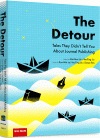 |
The Detour: Tales They Didn’t... 作者:Kuo-Wei Lai、Yeu-Ting Liu、Sony... 出版社:五南 |
| 圖書選購 |
| 型式 | 價格 | 供應商 | 所屬目錄 | $ 450 |
 五南文化廣場網路書店 五南文化廣場網路書店 |
研究方法、論文寫作 |
$ 465 |
 TAAZE 讀冊生活 TAAZE 讀冊生活 |
中文書 |
$ 465 |
 iRead灰熊愛讀書 iRead灰熊愛讀書 |
高等教育 |
|---|
| 圖書館借閱 |
| 國家圖書館 | 全國圖書書目資訊網 | 國立公共資訊圖書館 | 電子書服務平台 | MetaCat 跨館整合查詢 |
| 臺北市立圖書館 | 新北市立圖書館 | 基隆市公共圖書館 | 桃園市立圖書館 | 新竹縣公共圖書館 |
| 苗栗縣立圖書館 | 臺中市立圖書館 | 彰化縣公共圖書館 | 南投縣文化局 | 雲林縣公共圖書館 |
| 嘉義縣圖書館 | 臺南市立圖書館 | 高雄市立圖書館 | 屏東縣公共圖書館 | 宜蘭縣公共圖書館 |
| 花蓮縣文化局 | 臺東縣文化處 |
|
|
圖書介紹 - 資料來源:TAAZE 讀冊生活 評分:
圖書名稱:The Detour: Tales They Didn’t Tell You About Journal Publishing(第1版)
Rejection letters. Cryptic reviewer comments. APA nightmares.
Sound familiar?
Ten Moments of Chaos, Ten Lessons Learned is a behind-the-scenes tour of the academic publishing world, told through the misadventures of a rookie researcher named Ted. Each chapter dives into a moment of confusion, panic, or quiet triumph that every scholar eventually faces-whether it's deciphering a revise-and-resubmit decision or realizing that even your file name tells a story. This isn't your typical dry guide to publishing; it's honest, relatable, and surprisingly funny.
But beyond the chaos lies something deeper: the quiet, meaningful process of becoming a scholar who writes with purpose and resilience. With a mix of practical tips and heartfelt storytelling, this book is for anyone who's ever stared down a rejection email, questioned their worth, or dared to hope that their work might matter to someone. Flip to any chapter-and you just might find the inspiration you didn't know you needed.
作者簡介:
Author
Dr. Kuo-Wei Lai
An academic researcher with a Ph.D. in TESOL from the Department of English at National Taiwan Normal University, Dr. Lai's research interests include computer-assisted language learning (CALL),digital game-based learning, and second-language vocabulary acquisition.
EditorㆍAuthor
Dr. Yeu-Ting Liu
Yeu-Ting Liu, Ed.D. is Dean of the School of Teacher Education and Distinguished Professor in the Department of English at National Taiwan Normal University. Trained at Teachers College, Columbia University, his research bridges psycholinguistics and second language acquisition, with a focus on how cognitive traits and multimodal cues shape L2 learning. He has published extensively in SSCI-indexed journals, served as an editor and reviewer for leading publications, and led numerous national research projects in Taiwan.
Author
Dr. Sonya Fan
A full-time teacher at the Center for Academic Literacy and associate executive at the Resource Center for English as a Medium of Instruction at National Taiwan Normal University, Dr. Fan is active in teacher education, with research interests in international education and bilingual education.
Editor
Dr. Mei-Huei Liu
A distinguished professor and provost of National Taiwan Normal University, Dr. Liu works in many areas such as citizenship education, phenomenon-based learning, curriculum development, international education, multicultural education, teacher education, and gender issues.
EditorㆍAuthor
Dr. Yeu-Ting Liu
Yeu-Ting Liu, Ed.D. is Dean of the School of Teacher Education and Distinguished Professor in the Department of English at National Taiwan Normal University. Trained at Teachers College, Columbia University, his research bridges psycholinguistics and second language acquisition, with a focus on how cognitive traits and multimodal cues shape L2 learning. He has published extensively in SSCI-indexed journals, served as an editor and reviewer for leading publications, and led numerous national research projects in Taiwan.
章節試閱
Chapter 1 From Conference Hero to Journal Zero
You remember the feeling of seeing your name in the conference program, your PowerPoint slides ready, your voice shaking just a little less than usual. You step onto that conference stage and feel like a rising star. But here’s what no one tells you: just because you presented your research doesn’t mean you’ve published it. In fact, the applause from your conference might just be the first hook. The real test begins after you leave the podium, wh...
You remember the feeling of seeing your name in the conference program, your PowerPoint slides ready, your voice shaking just a little less than usual. You step onto that conference stage and feel like a rising star. But here’s what no one tells you: just because you presented your research doesn’t mean you’ve published it. In fact, the applause from your conference might just be the first hook. The real test begins after you leave the podium, wh...
顯示全部內容
作者序
Writing a Paper? Or Starring in an Academic Drama?
1. Why This Book?(A Not-So-Serious Guide to a Very Serious Process)
This book is for anyone who’s ever tripped on the road to academic publishing—got confused, felt crushed, or questioned their life choices—but still decided to give it another shot.
Whether you’re a master’s student, a PhD candidate, or a freshly minted assistant professor, publishing can often feel like an escape room without instructions: reviewer comments that feel lik...
1. Why This Book?(A Not-So-Serious Guide to a Very Serious Process)
This book is for anyone who’s ever tripped on the road to academic publishing—got confused, felt crushed, or questioned their life choices—but still decided to give it another shot.
Whether you’re a master’s student, a PhD candidate, or a freshly minted assistant professor, publishing can often feel like an escape room without instructions: reviewer comments that feel lik...
顯示全部內容
目錄
Preface:Writing a Paper? Or Starring in an Academic Drama?
Prologue 1 The Academic Rollercoaster
Episode 1: The Friendly Interview
Episode 2: The Brutal Interview
Episode 3: The Honest Interview
Final Call to Action: What You Need to Remember
Prologue 2 Pressure Makes Scholars
Episode 1: Opportunities Come to Those Who Take Initiative
Episode 2: Thrown Into the Deep End
Episode 3: When Pressure Turns into Preparation
Final Call to Action: What You Need to Remember
Chapter 1 From Co...
Prologue 1 The Academic Rollercoaster
Episode 1: The Friendly Interview
Episode 2: The Brutal Interview
Episode 3: The Honest Interview
Final Call to Action: What You Need to Remember
Prologue 2 Pressure Makes Scholars
Episode 1: Opportunities Come to Those Who Take Initiative
Episode 2: Thrown Into the Deep End
Episode 3: When Pressure Turns into Preparation
Final Call to Action: What You Need to Remember
Chapter 1 From Co...
顯示全部內容
|