| FindBook |
|
有 1 項符合
Christopher Marrison的圖書 |
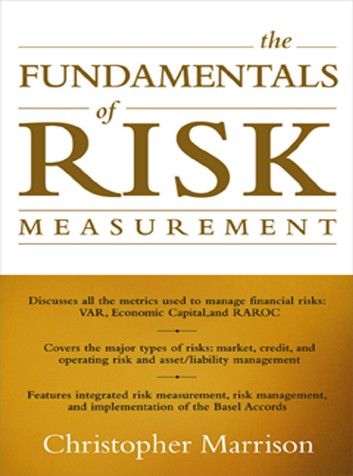 |
$ 1174 電子書 | The Fundamentals of Risk Measurement
作者:Christopher Marrison 出版社:McGraw Hill LLC 出版日期:2002-06-27 語言:英文  樂天KOBO - 工業與專業
- 來源網頁 樂天KOBO - 工業與專業
- 來源網頁  看圖書介紹 看圖書介紹
|
|
|
TABLE OF CONTENTS
Chapter 1: The Basics of Risk Management This chapter introduces how banks work. It describes how they make money, how they often lose money, and how they try to manage their losses. It includes thirteen short case studies showing how banks have lost money.
Chapter 2: Risk Measurement at the Corporate Level: Economic Capital and RAROC Chapter Two discusses the meaning of capital and how the risks that a bank faces are related to the amount of capital that the bank should hold. It then describes the two fundamental building blocks of integrated risk measurement: Economic Capital and Risk Adjusted Return on Capital (RAROC).
Chapter 3: Review of Statistics Chapter Three is useful for those readers who do not have a recent working knowledge of statistics. It reviews the statistical relationships that are commonly used in risk measurement and provides reference material for the rest of the book. Examples are provided using financial loss data.
MARKET RISK SECTION
Chapter 4: Background on Traded Instruments This chapter gives an overview of the main types of traded instruments: bonds, equities and derivatives. It gives a qualitative description of the instrument, examples of calculating the instrument’s value and the basic risk metrics such as duration and the Greeks. This chapter is useful for those readers who are new to the finance industry.
Chapter 5: Market Risk Measurement This chapter describes the most common ways to measure market risks: Sensitivity analysis, Stress testing, Scenario testing, Sharpe Ratio and Value at Risk. It gives detailed examples of using each of the metrics.
Chapter 6: The Three Common Approaches for Calculating Value at Risk Value at Risk (VaR) has become the standard approach for measuring market risk. This chapter is devoted to explaining the details of the three common approaches to calculating VaR: Parametric VaR, Historical VaR and Monte Carlo VaR. We work though increasingly complex examples and compare the strengths of each approach. (Note: many readers will be particularly interested in this chapter because the name “VaR” is well known and has a certain mystery)
Chapter 7: Value at Risk Contribution The Value at Risk Contribution (VaRC) is a useful way of pinpointing the source of the portfolio’s risk. VaRC can break down the risk by instrument, trading desk or market risk factor. Examples are given for several types of VaRC.
Chapter 8: Testing VaR Results to Ensure Proper Risk Measurement This chapter discusses the procedures required by regulators to backtest VaR calculators to check that their predictions of losses are consistent with market events.
Chapter 9: Calculating Capital for Market Risk VaR is used as the basis for calculating both Regulatory Capital and Economic Capital for Market Risks. In this chapter VaR also extended to measure the risk of Asset Management operations.
Chapter 10: Overcoming VaR Limitations Although VaR is the best single metric for market risks, is has several limitations. The limitations and typical solutions are discussed in this chapter.
Chapter 11: The Management of Market Risk This chapter concludes the market risk section by describing how the results of risk measurement are used by management to identify the sources of risk. It also describes the process of setting VaR Limits. (Note: readers should be particularly interested in VaR Limits because it is difficult and an important element in controlling a bank’s risk).
ASSET/LIABILITY MANGEMENT SECTION
Chapter 12: Introduction to Asset Liability Management Asset Liability Management (ALM) is primarily concerned with the interest rate and liquidity risks that are created when commercial banks take in short term deposits from customers and give out long term loans. This chapter describes how those risks arise and the risk characteristics of different types of deposits and loans.
Chapter 13: Measurement of Interest Rate Risk for ALM This chapter discussed the primary techniques used to measure interest rate risk: Gap reports, Rate shift scenarios and Simulations
Chapter 14: Funding Liquidity Risk in ALM The measurement of liquidity risk is broken into three groups: expected, unusual and crisis events. Measurement techniques are given for each group.
Chapter 15: Funds Transfer Pricing and the Management of ALM Risks A key use of asset/liability measurement is the calculation of the fair price at which funds should be lent from one department to another within a bank. This is one of the keys to integrated risk measurement and is a critical component in measuring risk-adjusted profitability and setting prices to customers. A typical balance sheet is used to illustrate how transfer pricing works in detail.
CREDIT RISK SECTION
Chapter 16: Introduction to Credit Risk This chapter discusses the sources of credit risk and how measurement is used to manage the risks
Chapter 17: Types of Credit Structure For readers who are unfamiliar with lending operations, we discuss the ways that credit exposures are structured in commercial and retail lending. It also describes the calculation of credit exposure for derivatives trading operations and gives an overview of credit derivatives.
Chapter 18: Risk Measurement for a Single Facility This chapter shows how the Expected Loss and Unexpected Loss for a loan can be calculated from the Probability of Default, Loss In the Event of Default, Exposure at Default and the Grade Migration Matrix.
Chapter 19: Estimating Parameter Values for Single Facilities One of the main difficulties in credit risk measurement is the estimation of values for Probability of Default, Loss Given Default and Exposure at Default. This chapter discusses estimation techniques such as Discriminant Analysis and the Merton Model. It also gives parameter values that can be used as the basis for the reader’s own models. The parameter values are used in examples to demonstrate how the credit risk calculations are used.
Chapter 20: Risk Measurement For A Credit Portfolio: Part One To estimate the overall risk for a portfolio many credit instruments, we must examine the correlation between losses. This chapter describes the Covariance Credit Portfolio Model and the different approaches available for estimating default correlations. It also describes how the correlations can be used to estimate the Unexpected Loss Contribution and the Economic Capital for a single facility within a portfolio.
Chapter 21: Risk Measurement For A Credit Portfolio: Part Two This chapter describes the four other widely used approaches for estimating the risk of credit portfolios: the actuarial model, the Merton-based simulation model, the macro economic default model and the macro economic cashflow model used for structured and project finance. It concludes with a section describing how the models can be combined in a unified framework to create an integrated simulation of all the bank’s risks
Chapter 22: Risk Adjusted Performance and Pricing for Loans Knowing the economic capital for a loan, this chapter shows how to calculate the minimum price that should be charged to a loan customer. The analysis shows how to include multi-year effects such as grade migration. Illustrative examples are included. (Note: this chapter should be of interest to readers because loan pricing is another difficult and important subject that is rarely discussed in other books)
Chapter 23: Regulatory Capital for Credit Risk The Basel Committee on Banking Supervision (often called the BIS) is planning fundamental changes to the way that banks must calculate the capital that they hold. The new calculations will be very similar to the calculations described in the rest of this book for economic capital. This chapter summarizes the history of the Capital Accords then compares the different approaches that the BIS will allow. It also gives a standard plan for implementing the new Accords. (Note: this should be of interest to readers because the shift to BIS measurement is of major importance, it will be difficult for most banks, and it must be completed by 2005)
OPERATING RISK SECTION
Chapter 24: Operating risk The quantification of Operating Risks is on the frontier of the industry’s understanding of risk measurement. The risk estimation approaches can be categorized as either qualitative, structural or actuarial. These approaches are described including Key Risk Indicators and the BIS approaches.
INTEGRATED RISK SECTION
Chapter 25: Inter-risk Diversification and Bank-Level RAROC This chapter describes how all the models are linked to calculate Economic Capital and Risk Adjusted Profitability for the Bank as a whole. It concludes with of the steps normally required to implement the bank-wide measurement of Economic Capital and RAROC.pital and RAROC.
|